

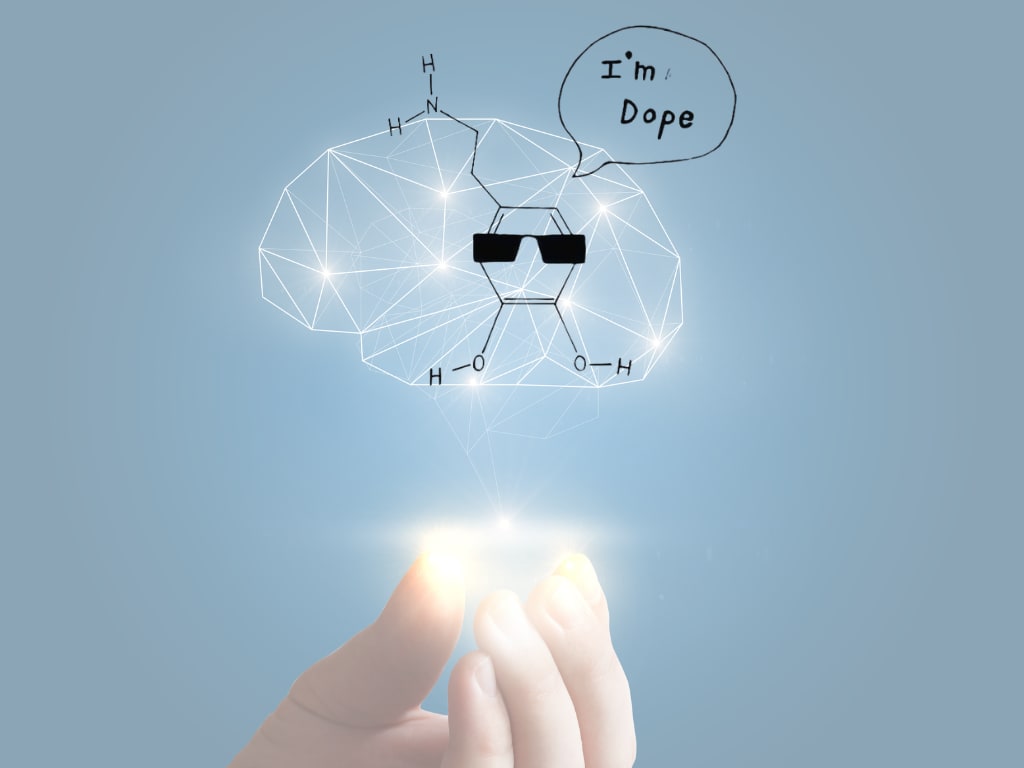
You may have heard of a little rascal named Dopamine. This tiny molecule lives in your brain and body. Even if you're not hungry, it'll makes you crave that yummy pizza from the commercial you just saw. Not just a neurotransmitter, as a catecholamine, Dopamine lives a double life. It's true that it's primary residence is in your brain as a neurotransmitter but it also roams around your body like a nomad, acting like a hormone. And it makes you crave things
.
We're going to talk about just how much of a dopamine boost you get from different substances and activities but to really get it, you'll need to understand the basics. In the CNS, it has a sensible day job; relaying quick, instant messenger-like signals around your brain and spinal cord. It tells the system, "Hey, we like this. How do we get more of it?" It’s not about pleasure directly — it drives motivation, curiosity, reward-seeking, and habit formation.
It's side-gig as a hormone is all over the place. It's a hustler molecule; a jack-of-all-trades. In your body, it send slower, email-like messages that balance out signals from other hormones throughout your body. It helps regulate blood pressure, insulin and digestion, as well as inflammation and immune response.
So, an experience or activity occurs and the intensity of dopamine in the brain tells you how good it is and motivates you to get more of it. Meanwhile, throughout the rest of your body, dopamine is socializing and making deals with other molecules to keep things humming along.
Anatomy of a Craving
Let's talk about desire and craving. McDonald's french fries, sex, a cold drink, or drugs - it all works the same in your brain. You don't get pleasure or a high from the substance, rather from the neurochemical response to it in your brain. When you crave something, a loop of neurotransmitters get triggered. It goes something like this: Dopamine says want it, glutamate remembers where it is, serotonin says you’ll feel better after, and norepinephrine yells GO GET IT NOW.
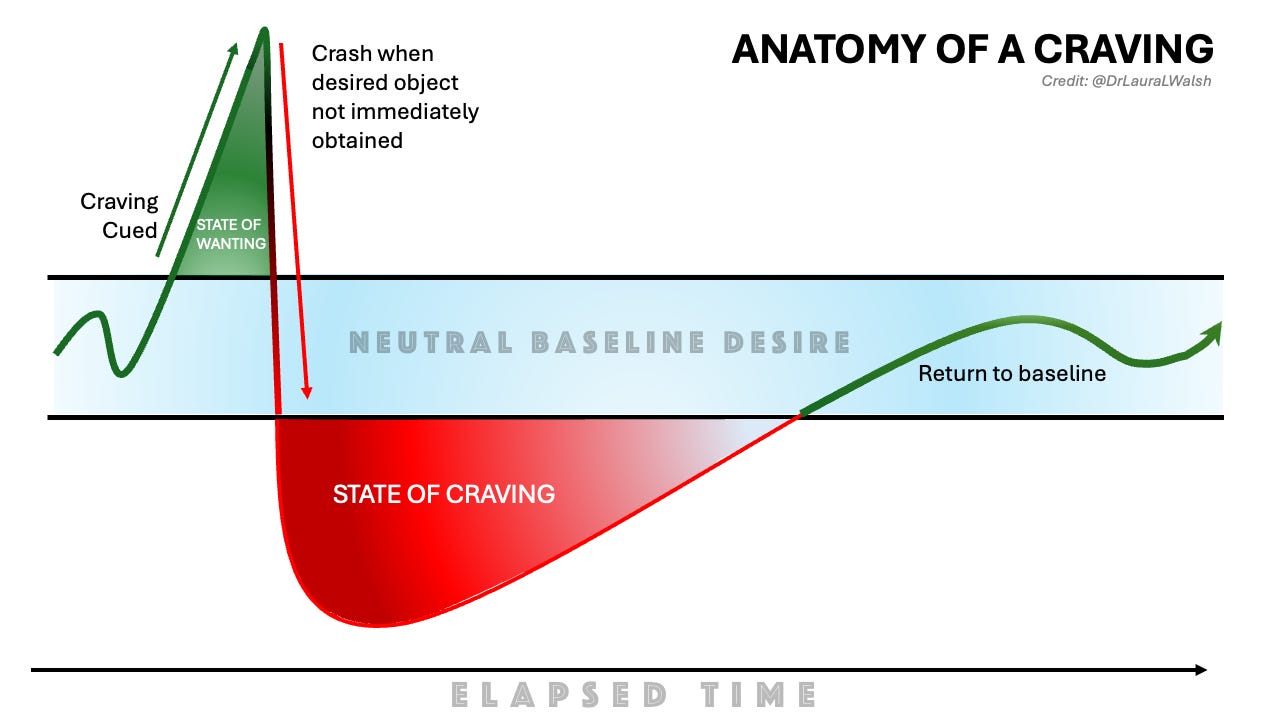
After you're cued - whether by the pizza ad or a drug trigger - your brain goes into a state of wanting. When what you want isn't immediately available, you crash into a state of craving. Craving trips a cascade of signals pushing you to go get the substance now. It takes over your brain and dips mostly deeply right after the crash. If you don't give in, over time your brain gives up the fight and you return to the neutral state of not wanting anything in particular. This is the cool thing - craving is all consuming but temporary. Wait out the intense state of craving and you'll get to the other side - unless you're cued again, then it starts all over.
Dopamine and Reuptake
Let's talk neuroscience, specifically reuptake for a second. Neurons pass along messages by releasing neurotransmitters into the space (synapse) between it and another neuron. They send out neurotransmitters into the space then suck up the extra ones that didn't make it over to the other neuron. This is reuptake - the brain's way of keeping things tidy.
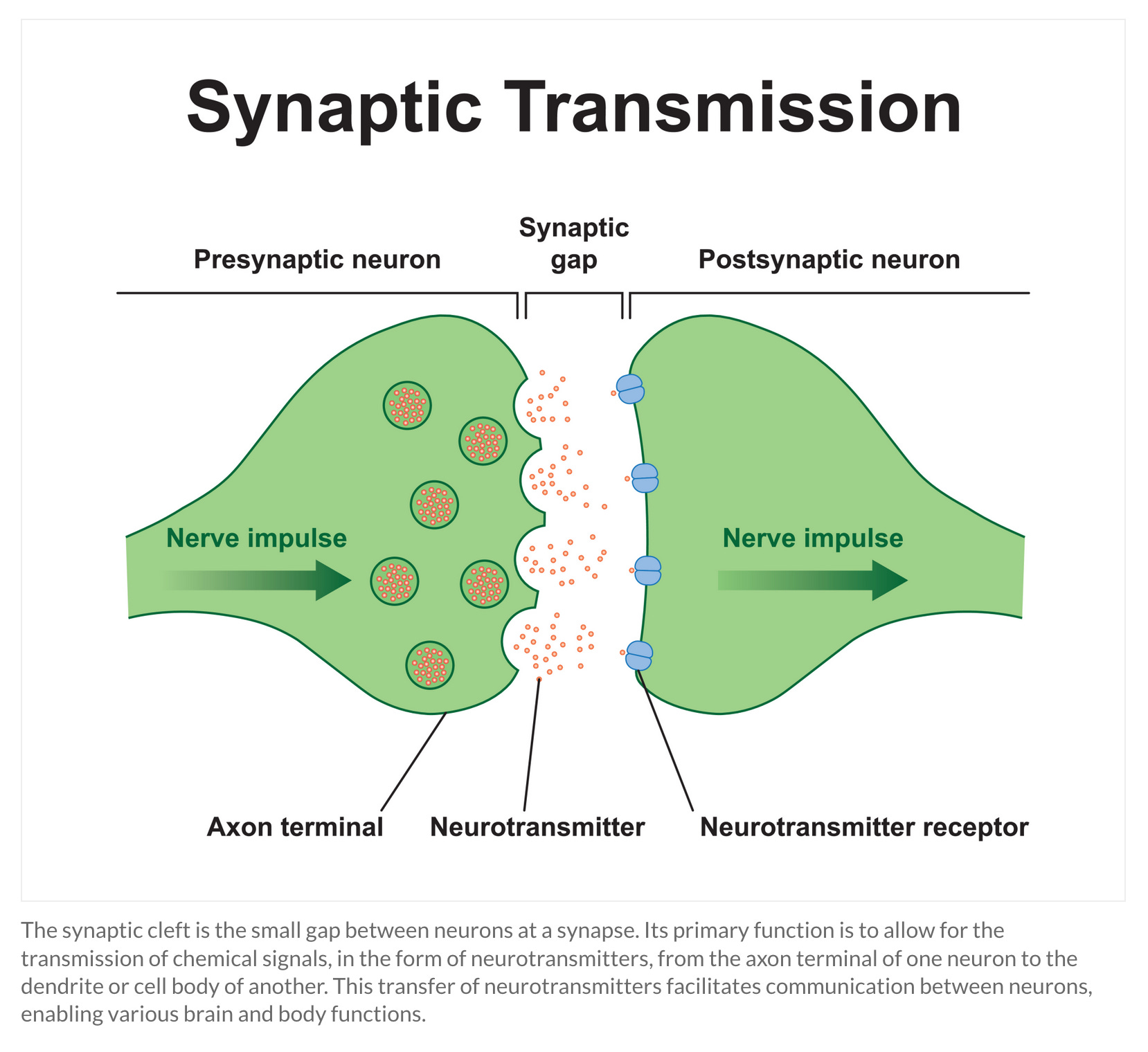
You've heard of SSRI's like Prozac and Effexor - selective serotonin reuptake inhibitors. These drugs increase serotonin floating around in your brain by inhibiting reuptake. SSRI's slow down the sucking up process so more serotonin is hanging around between neurons and can connect up with the other neuron.
Stimulants, like caffeine and cocaine, act as SDRI's - selective dopamine reuptake inhibitors - same concept, different molecule. They work by keeping more dopamine around between the neurons. Depending on the substance and amount, the result is more energy and motivation.
I know this is sort of dense stuff but it's relevant to really understanding a bunch of complex topics so hang in there. Just to recap, for our purposes, dopamine tells the brain what to pay attention to because it's good, pleasurable or interesting. The more dopamine, the more intense you like something. Cues or triggers kick off craving and different substances make more dopamine available between neurons.
Dopamine Blues
Whenever you're doing something tedious, boring or unpleasant, your brain releases less dopamine and thus, nothing gets tagged as salient or rewarding. You'll even have less motivation for the interesting things. It's easier to get distracted because when understimulated, your brain starts looking around for the next shiny object. You might find your hand reaches for the phone or you suddenly find you've got 20 browser tabs open. Using your prefrontal cortex to override this urge (i.e. ugh, I have to focus) takes effort and drains emotional energy reserves.
A scattering of research investigates dopamine deficiency and insensitivity/desensitivity - basically not having enough dopamine to release or enough sensitivity to dopamine after it's released. Think of neurons as locks and neurotransmitters as keys. Whenever you have larger, more intense dopamine signaling, you can either deplete your stores or burn out receptors. That means less keys and broken locks. Boo.
Dopamine Detox
To reduce instant gratification and overstimulation, you might try dopamine fasting. This idea is to take breaks from "dopamine rush" activities like using your phone or playing video games. "Touch grass" is the phrase these technology eschewing, tree lovers like to say. Research suggests good results - detoxing leads to increased mental clarity, mood and self control, reduced anxiety and impulsivity, as well as a desire to explore new activities.
Of course, there's potential down sides. Some extremes such as isolation or food deprivation aren't great. Plus, a break from social media when you don't have friends nearby to fill up your dance card is rough at first. My advice follows the Chesterson's fence idea - don't remove something until you know why it's there. Make friends in real life before quitting social media (but please, keep reading REFRAMED).
Dopamine Baseline and Above
Everyone has a dopamine baseline humming along. This is a neutral state where you're neither bored nor interested. Nothing in particular is going on in your brain. It's kind of imaginary because I don't know about you but there's always something clicking along in my brain. But just try to picture it as a temporary, even state so we can compare the percentage over baseline. Too little dopamine circulating around and nothing is interesting to you - you're apathetic and don't care. Too much wires you up and makes everything salient. You'll get impulsive and manic with overstimulation. For comparison, let's look at substances or activities that give you a boost of dopamine over baseline.
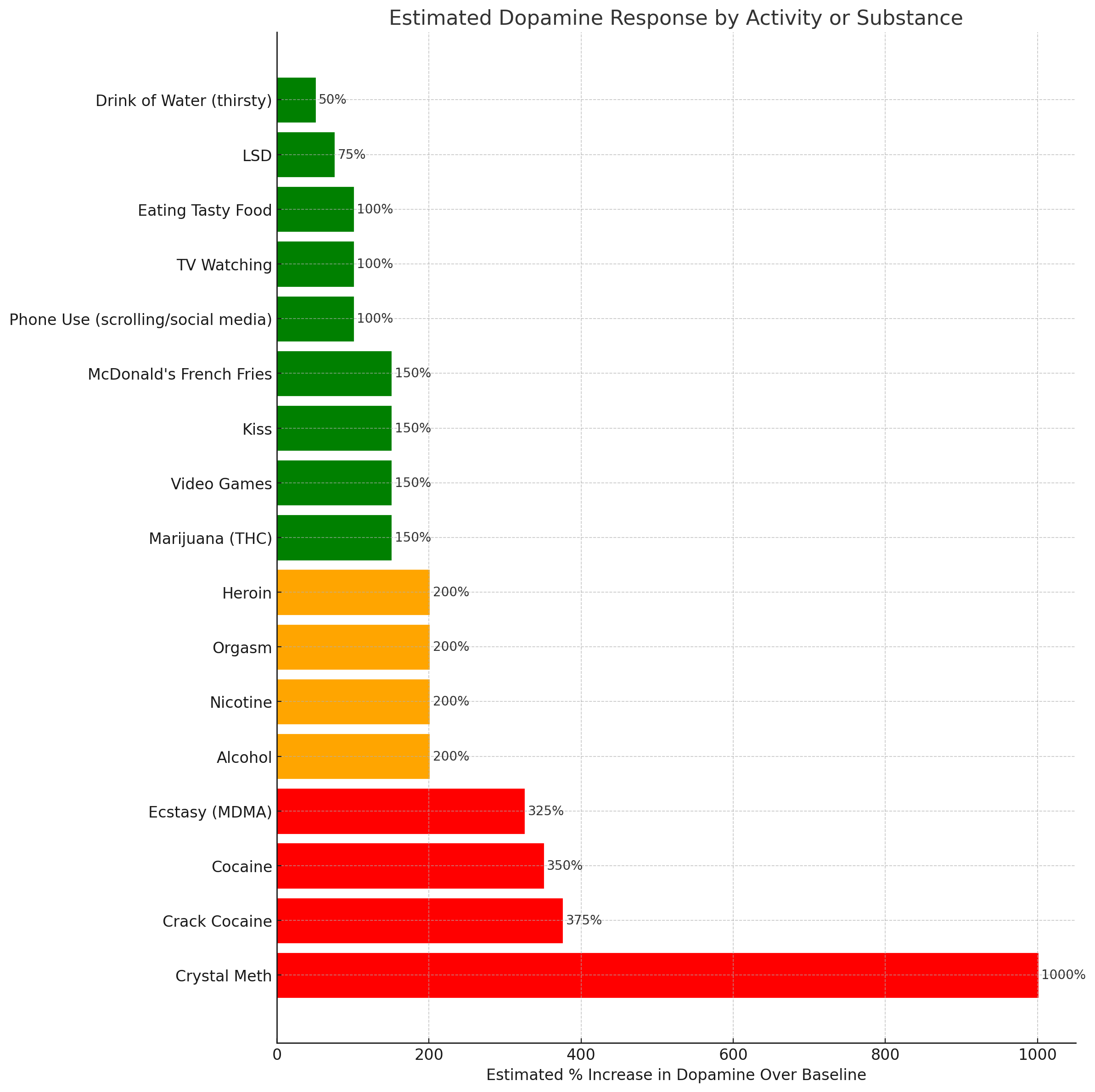
When you're thirsty, a cool drink of water increases dopamine 50% over baseline. An orgasm (200%) just barely inches out McDonald's french fries and weed (both 150%). . If you're looking to bump up the dopamine, LSD (75%) isn't going to do it; you're better off scrolling on your phone or watching tv (both 100% each) or playing video games (150%).
Whether your evening includes an orgasm, beers and a smoke, or heroin - each a 200% increase - you're going to have a good time (at least temporarily). Party all night long on ecstacy/MDMA/Molly (325%) and pay for it days after with dopamine (and serotonin) deficiency. Once you get into cocaine (350%), crack cocaine (375%), or crystal meth (1000%), it's more rewarding and more difficult to use recreationally.
For contrast, we have to take a look at the good things in life. These activities are generally natural, healthy and not addicting. They can be habit forming but it's the good kind of habits.
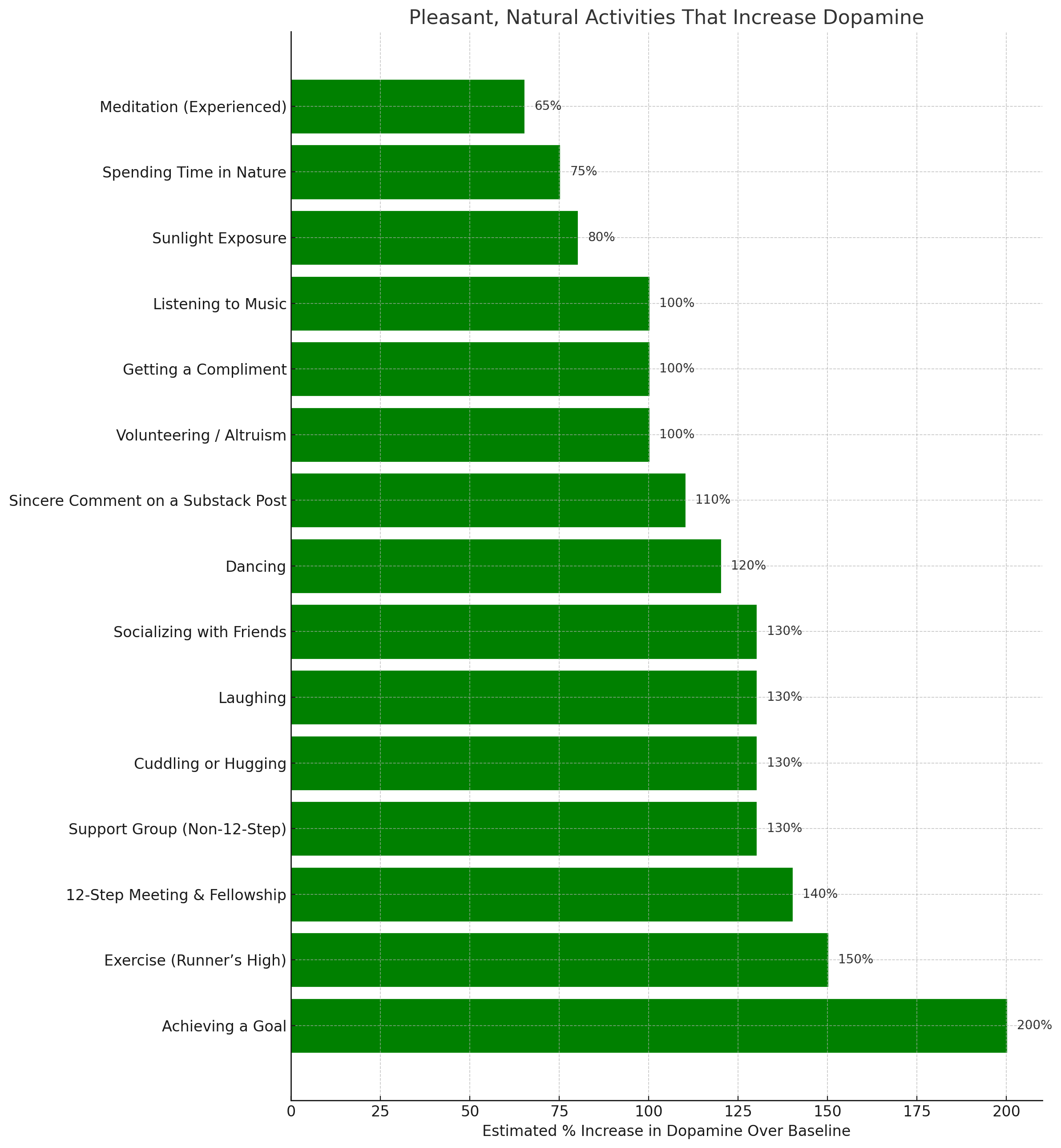
Comparing a runner's high (150%) to crystal meth (1000%) starts to make the boot strap argument on how to treat addiction a little ridiculous. Illicit drugs that induce much higher dopamine rushes start to crowd out the need for anything else. How can spending time with friends (130%), laughing (100%), drinking water when thirsty (50%) or even tasty food (100%) compare with the reinforcing spikes of illicit drugs? Addict behavior starts to make sense through this lens. The regular human brain rewards pale in comparison to the drugs' effects, replacing basic human needs for food, water, and social connections. It's amazing anyone ever quits and chooses recovery (140%).
My hope is that you see how you can influence your brain and experiences. Dopamine highs are tempting but everything has tradeoffs. Too high for too long and you'll pay the price of a depleted supply for days to months after. Everything we do or take into our bodies are habits. The key is optimal stimulation - enough dopamine signaling to get you feeling good while staying in balance. That's a sustainable life. My question to you is what stimulation will you choose next? Will you continue to scroll on your phone (100%)? Make a sincere comment on this essay (110%)? Get out in nature (75%)? The choice is yours.
I need your help to get the word out. Sharing this essay or sharing a quote from it on Substack or other social media helps me reach others. I appreciate your support.
This is so spot on. It’s like we’ve hacked our own wiring and then acted shocked that things short-circuit. We’ve turned survival mechanisms into party tricks—dopamine fireworks for just existing. And French fries? Yeah, they know what they’re doing. That salt-fat-sugar combo hits like a slot machine win every damn time.
As someone who’s spent years coaching people through these traps (and let’s be honest, falling into a few of them myself), I’ve seen firsthand how this plays out: we crave the hit, get the hit, then feel hollow after because the hit wasn’t the thing we were really chasing. But man, it’s hard to explain that to someone mid-binge on TikTok or buried in a bag of Doritos.
So yeah, thank you for writing this. We need more people pointing out that maybe, just maybe, the thing that feels good isn’t always good for us. And we need to start asking better questions than “Does it feel good right now?” Because the answer is usually yes. And that’s the problem.
"....detoxing leads to increased mental clarity, mood and self control, reduced anxiety and impulsivity, as well as a desire to explore new activities."
I personally don't have these issues even with heavy phone time. Maybe it's because a lot of my Substack/TT scrolling is educational and/or kittens and mental health support. lol but my therapist tells me I'm a bit of a rare bird.
I've always been kind of predisposed to being happy and I never stay down for long.
I listen to music a lot and have lots of great tools for mental health.
Really enjoyed this post!